
Ambisonic Residency at the SOUND/IMAGE Research Centre
Human Substratum: Vocal Experiments in Ambisonic Space
“The ‘grain’ is the body in the voice as it sings, the hand as it writes, the limb as it performs.” – Roland Barthes (The Grain of the Voice)
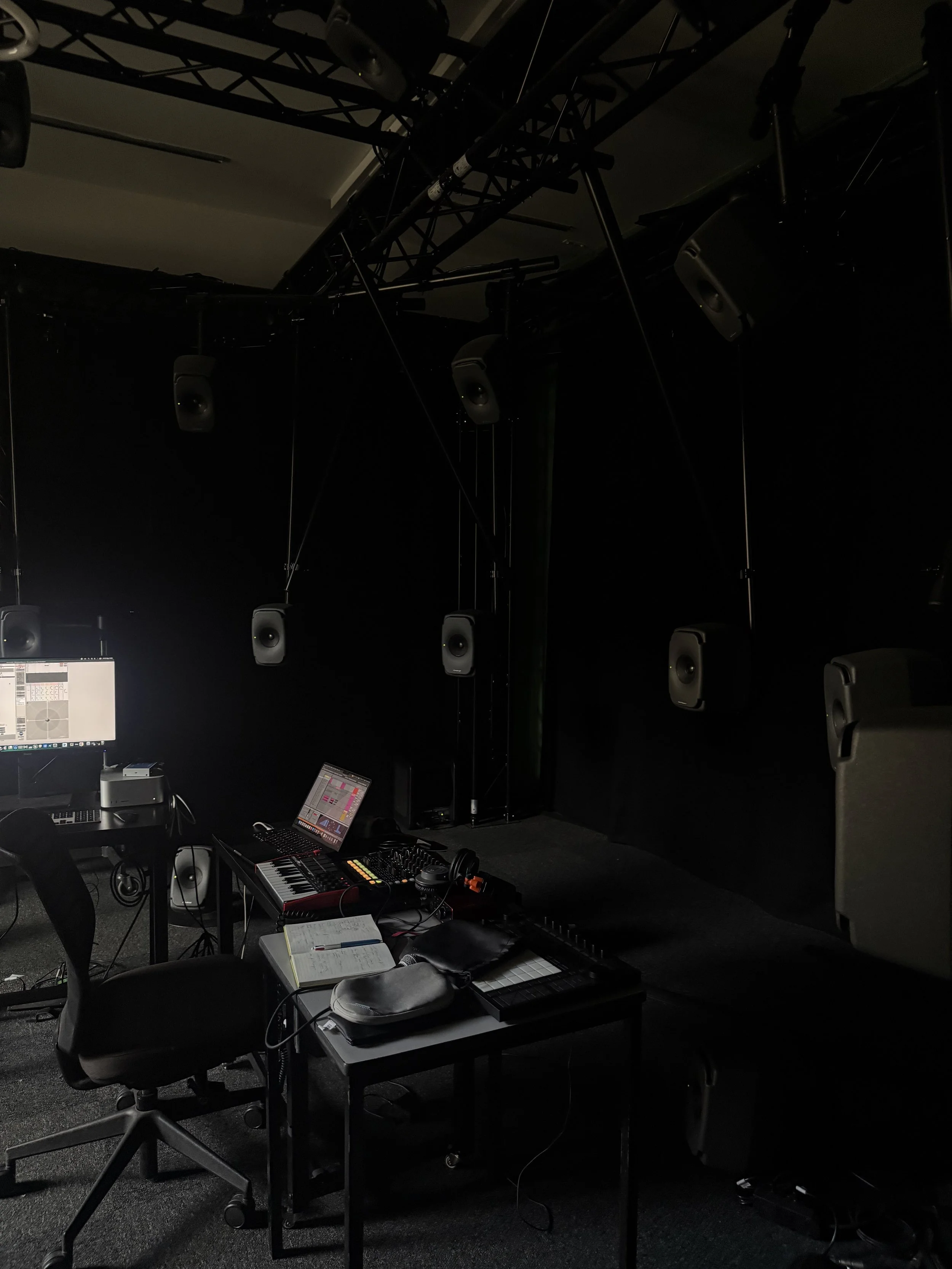
In August, I was fortunate enough to undertake a week-long residency creating from the SOUND/IMAGE Research Centre’s Immersive Sound Lab at the University of Greenwich. Marking my first foray into working with ambisonic sound with their 32.4 speaker array, my time in the lab primarily centred on vocal experiments in spatio-temporal dislocation and playing with the human substratum beneath the electronic.
1. Memory is forever dislodging and dislocating
In 2023, I wrote a piece Toska for 27 speakers, which sought to affix memories in time by attaching them to specific speakers in a desperate bid to grasp onto my familial-cultural past and future. This first experiment was an inversion of that idea in ambisonic space, one that instead surrendered control, treating spatial diffusion as where and distortion as when.
Having recently visited Bulgaria and Armenia, I was inspired by three elements key (depending on the region) to Eastern European and Eurasian folk song: the drone, ‘crooked’ drone, and melody. Besides the drone, each element was made from my voice which, dissected and implanted into the space, became schizophonic: severed at the microphone from the body (mine) that produced it, and rendered acousmatic, split and scattered across the 32.4 speaker array.
The drone is the first element of (unexpected) dislocation. Despite holding an intense, physically centred presence, it defies localisation–its long bass wavelengths flood the room, such that the human ear cannot place the sound. Over it lie the ‘crooked’ drones, two harmonies drifting microtonally above the bass-drone with quasi-periodicity to achieve both spatial and harmonic incommensurability. As they never fully correlate, only slightly touch, their voice and resonance lingers in the space between the speakers. Finally, the melody hangs and whirls frantically, shattering into fragments through violent granulation, or cohering enough such that its human origin peeks from underneath.
Across these elements, the psychoacoustic effect is one of never quite being able to grasp onto any feature before it moves on, whether displaced in space or decomposed into grains of noise, from which rhythm emerges to dislocate us further in time. The desired affect is one moving from unease to a willing release, as the sounds act on the body as a resonance chamber at the edges of human audition, whether in frequency (bass) à la Steve Goodman’s unsound or in time, through Curtis Roads’ microsound. Control over my memories, past and future, is forever dislodging and dislocating. Only the steady hum of the drone remains. Which, too, will inevitably diffuse.
2. Restlessness and relief in the skull of the resonance chamber
The second experiment was more technical play, an exercise in shifting energetic states to test how far the psychoacoustic affect could be pushed, from gruelling restlessness to relief and release. It consisted of four one-second vocal harmonies I recorded in the lab, and a drum palette also made entirely from my voice.
Initially, the snippets are placed equidistantly from the listening position at maximum spread, such that they, too, are stripped of any sense of fixed directionality. Each bar or so, they swap places with each other, in a frenzy of musical chairs. Tredging forward into agitation, the pattern is flipped on its head, such that the voices are redistributed in polyrhythmic Euclidean patterns. At intervals, all the voices converge–by Euclidean design or force–on the origin, meeting the listener in the skull of their resonance chamber. Here, the perpetual spatio-temporal dislocation returns as they are no longer somewhere; instead they are nowhere. When they do release back into the previous, more danceable, Euclidean patterns and a bass enters, however, there is an unnerving urge to sigh an uhhhh, with the plaisir of relief. This experiment tests the faculties of human audition and how much uncomfortable, high-pitched, circus-like movement we can withstand before coming ourselves apart. I found out myself in the lab.
Working with the drums made from my voice, I played with varying how much of the human was revealed, such that only deep listening, or being positioned at the right spot, at the right moment, would indicate the human origins of the technological. This is where I would like to next take my research and creative practice in ambisonics.